
Specifications and workshop reference information for the 1984 Honda CR500, including engine, chassis, service data and setup details.
Note: Specs are compiled from factory data, manuals and owner feedback. Bikes vary — if yours is different, jump into the forum and share it.
| Engine Type | Liquid-cooled, 2-stroke, single-cylinder |
| Displacement | 491 cc |
| Bore × Stroke | 89.0 × 79.0 mm |
| Compression Ratio | 7.0:1 |
| Maximum Power | Approx. 60 hp |
| Maximum Torque | |
| Carburetor | Keihin | Replacement Options |
| Lubrication | Premix |
| Fuel Mix Ratio | 20:1 | Premix Calculator |
| Ignition | CDI |
| Spark Plug | NGK B9ES |
| Spark Plug Gap | 0.6–0.7 mm |
| Transmission Type | 5-speed manual |
| Clutch | Wet multi-plate |
| Final Reduction | Chain drive |
| Overall Length | 2,200 mm |
| Overall Width | 820 mm |
| Overall Height | 1,250 mm |
| Wheelbase | 1,480 mm |
| Ground Clearance | 340 mm |
| Fuel Tank Capacity | 9.0 L |
| Bearing Sizes | Bearing Finder |
| Frame Type | Steel single cradle |
| Front Suspension | Telescopic forks | Fork Oil Levels |
| Rear Suspension | Pro-Link monoshock |
| Front Suspension Travel | |
| Rear Suspension Travel |
| Front Tire | 3.00-21 | Tyre Size Guide |
| Rear Tire | 4.50-18 | Tyre Size Guide |
| Front Brake | Disc brake |
| Rear Brake | Disc brake |
| 1981 Honda XR500 |
| 1982 Honda XR500 |
| 1982 Honda XL500 |
| 1983 Honda XR500 |
| 1984 Honda XR500 |
| 1980 Honda XL500 |
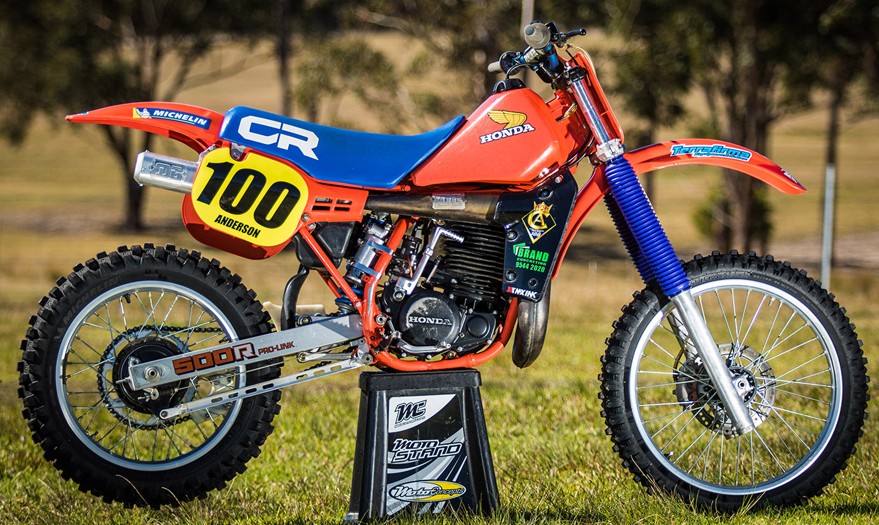
The 1984 Honda CR500R occupies a special place in motocross history. It was the first motorcycle to carry the CR500 name, beginning a model line that would eventually become legendary for enormous two-stroke power, simplicity and a reputation that still surrounds the bike decades later. But the original 1984 machine was quite different from the later CR500s most riders remember.
Honda created the CR500R by developing the big-bore concept it had previously explored with the CR480R. The result was a 491cc air-cooled two-stroke single designed to produce serious open-class performance. With a large-capacity engine in a relatively light motocross chassis, outright horsepower was only part of the story. Torque and throttle response made the bike demanding, particularly on loose or rough tracks where an enthusiastic right hand could quickly overwhelm rear-wheel traction.
Feeding that big two-stroke was a large Keihin carburettor, and correct jetting remains especially important for owners today. A big-bore air-cooled two-stroke needs the correct fuel mixture not simply for performance but also to help control operating temperature and avoid the potentially expensive consequences of running excessively lean.
The 1984 CR500R also represents the final air-cooled chapter of Honda's big-bore motocross development. Honda moved the CR500 to liquid cooling for 1985, meaning the first-year model stands apart mechanically and visually from nearly every CR500 that followed. That distinction has made complete and original 1984 examples increasingly interesting to collectors and restorers.
Chassis development was equally important. Honda used its Pro-Link single-shock system at the rear, continuing the rapid suspension development that had transformed motocross motorcycles during the early 1980s. Restoring the Pro-Link rear suspension and linkage correctly is important on a surviving machine because worn bushes, bearings and shock components can make an old CR500 handle considerably worse than Honda intended.
At the front, the Showa telescopic forks had the difficult job of controlling a light motorcycle powered by an extremely large two-stroke engine. Suspension condition and setup remain critical for anyone intending to race one today rather than simply display it.
Power reached the rear wheel through a conventional chain final drive. On a motorcycle producing this much torque, the condition and adjustment of the chain and sprockets deserve particular attention. What might be minor wear on a smaller trail bike becomes considerably more important when nearly 500cc of two-stroke power is repeatedly being delivered through the drivetrain.
The 1984 CR500R was not yet the refined, liquid-cooled monster that later made the CR500 name famous. Instead, it was something rawer: an enormous air-cooled two-stroke engine combined with rapidly developing 1980s motocross chassis technology.
That is precisely what makes the first CR500 so interesting today. It marks the beginning of a model that would survive for nearly two decades and become one of the most recognised open-class motocross motorcycles ever built.
Before the CR500 became a legend, Honda had to build the first one. This was it.
Discuss vintage motocross bikes, restorations, tuning and riding.