
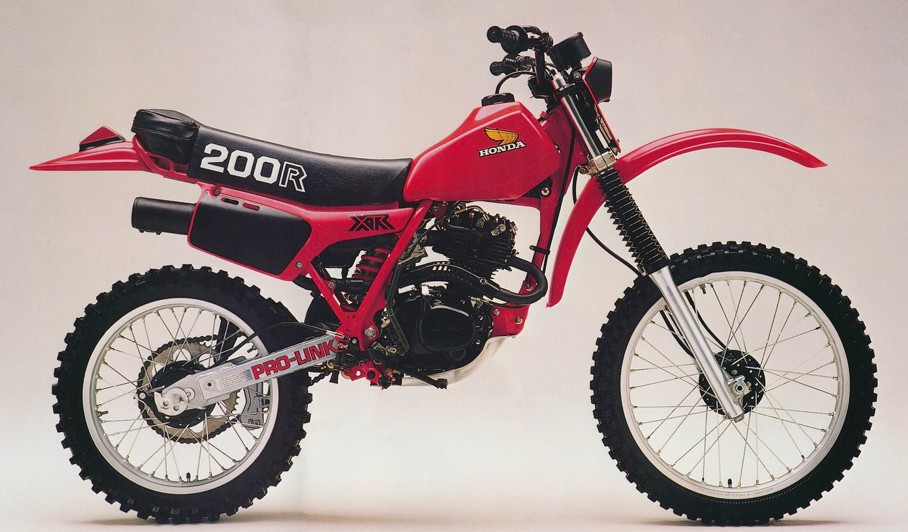
Specifications and workshop reference information for the 1981 Honda XR200, including engine, chassis, service data and setup details.
Note: Specs are compiled from factory data, manuals and owner feedback. Bikes vary — if yours is different, jump into the forum and share it.
| Engine Type | Air-cooled 4-stroke SOHC single cylinder |
| Displacement | 195 cc |
| Bore × Stroke | 65.5 × 57.8 mm |
| Compression Ratio | 9.0:1 |
| Maximum Power | Approx. 17 hp @ 8,000 rpm |
| Carburetor | Keihin | Replacement Options |
| Lubrication | Wet sump |
| Fuel Mix Ratio | Petrol only |
| Ignition | CDI |
| Spark Plug | NGK DPR8EA-9 |
| Spark Plug Gap | 0.8–0.9 mm |
| Valve Clearance | Intake: 0.05 mm / Exhaust: 0.05 mm cold |
| Starting System | Kickstart |
| Transmission Type | 6-speed |
| Clutch | Wet multi-plate |
| Final Drive | Chain drive |
| Wheelbase | Approx. 1,345 mm |
| Ground Clearance | Approx. 270 mm |
| Fuel Tank Capacity | Approx. 9.0 litres |
| Bearing Sizes | Bearing Finder |
| Frame Type | Steel single cradle |
| Front Suspension | Telescopic forks | Fork Oil Levels |
| Rear Suspension | Twin shock swingarm |
| Front Brake | Drum |
| Rear Brake | Drum |
| Front Tire | 2.75-21 | Tyre Size Guide |
| Rear Tire | 4.10-18 | Tyre Size Guide |
| 1979 Honda XL200 |
| 1980 Honda XL200 |
| 1981 Honda XL200 |
| 1982 Honda XL200 |
The 1981 Honda XR200 came from an era when Honda’s XR range was establishing a reputation for simple, dependable four-stroke motorcycles that could spend the morning on a trail and the afternoon being ridden hard around a paddock. It was not the biggest or most powerful XR in the range, but that was precisely the point. Light weight, manageable power and straightforward engineering made the XR200 an extremely usable motorcycle.
At the heart of the 1981 XR200 was Honda’s air-cooled, single-cylinder four-stroke engine. Its power delivery was considerably more forgiving than the two-stroke motocross machinery of the period. Rather than demanding constant clutch and gear work, the XR could find traction, pull from relatively low revs and keep going. For modern owners restoring an original machine, correct carburetion remains important; worn jets, air leaks and decades of previous-owner adjustments can transform an otherwise healthy engine into a frustrating starter. The VMXOwners carburettor reference and replacement guide is useful when identifying options for ageing induction components.
The chassis followed the same practical philosophy. Conventional telescopic forks, twin rear shocks and drum brakes were hardly exotic even in 1981, but the XR200 was intended to be durable and predictable rather than a works motocrosser. Its relatively compact dimensions made it especially enjoyable in tight terrain where a heavier open-class four-stroke could become hard work.
Suspension condition matters considerably more today than it did when these motorcycles were relatively new. Forty-five years of use can leave fork oil resembling sludge, springs tired and damping inconsistent. Before assuming an old XR needs expensive modifications, returning the standard suspension to good working condition is worthwhile. Correct fork oil levels and servicing information and careful attention to the rear shocks can make a surprisingly large difference.
Gearing is another area where surviving XR200s often differ from original specification. Previous owners commonly changed sprocket sizes to suit farm work, tighter trails or higher-speed riding. When recommissioning a bike, inspect the complete final drive rather than replacing only the chain. Hooked sprocket teeth, tight chain sections and worn adjusters are signs that the system needs attention. The VMXOwners chains and sprockets reference provides a useful starting point when sorting out the final drive.
Tyres can similarly transform the little Honda. Old rubber may still have plenty of visible tread while providing very little grip. Matching modern replacements to the original wheel dimensions is far preferable to judging suitability by appearance alone; the vintage motorcycle tyre size guide can help when comparing older and current tyre markings.
What makes the 1981 XR200 appealing today is much the same as what made it successful when new. It is approachable, mechanically uncomplicated and genuinely enjoyable at sensible speeds. It does not need huge horsepower to entertain its rider.
For vintage trail riding, vinduro events, property use or simply owning an early Honda XR that can still be ridden rather than permanently displayed, the 1981 XR200 represents one of Honda’s most enduring ideas: keep the motorcycle light, usable and tough, and let the rider provide the adventure.
Discuss vintage motocross bikes, restorations, tuning and riding.