
Specifications and workshop reference information for the 1976 Suzuki RM250A, including engine, chassis, service data and setup details.
Note: Specs are compiled from factory data, manuals and owner feedback. Bikes vary — if yours is different, jump into the forum and share it.
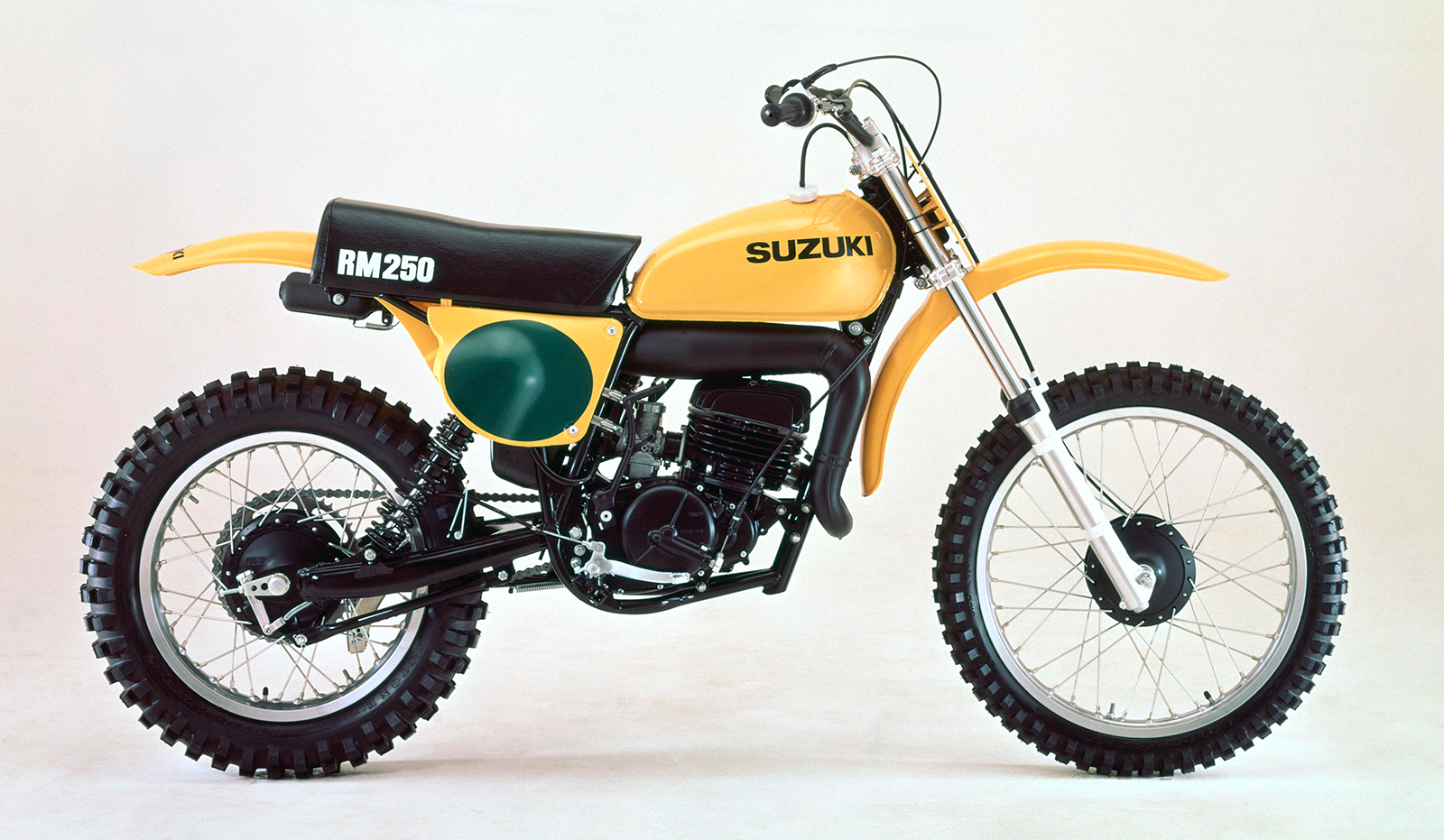
| Model | Suzuki RM250A |
| Year | 1976 |
| Engine Type | Piston-port crankcase-reed, 2-stroke single |
| Displacement | 246 cc |
| Bore x Stroke | 70 x 64 mm |
| Compression Ratio | 7.1:1 |
| Carburetor | Mikuni VM36SS (36 mm) | Replacement Options |
| Air Filtration | Oiled urethane foam |
| Ignition | Magnetically triggered CDI |
| Power | 29.3 hp @ 7500 rpm |
| Torque | 20.52 lb-ft @ 7500 rpm |
| Fuel Capacity | 2.1 gal (8 litres) |
| Oil System | Premix (mixed with fuel) |
| Primary Drive | Spur gear 60/22 |
| Final Drive | #520 chain |
| Sprockets | 50/13 |
| Transmission Oil | 900 cc |
| Wheelbase | 56.7 in (144 cm) |
| Seat Height | 33 in (83.8 cm) |
| Ground Clearance | 10 in (25.4 cm) |
| Weight | 231.5 lb (105 kg) |
| Test Weight | 391.5 lb (177.6 kg) |
| Bearing Sizes | Bearing Finder |
| Front Tire | 3.00 x 21 | Tyre Size Guide |
| Rear Tire | 4.50 x 18 | Tyre Size Guide |
| Front Brake | 130 x 28 mm drum |
| Rear Brake | 150 x 29 mm drum |
| Brake Swept Area | 38.86 sq in |
| Rake / Trail | 30° / 4.96 in |
| 1968 Yamaha DT1 250 |
| 1971 Rickman Montesa 250 |
| 1971 Yamaha DT1E 250 |
The 1976 Suzuki RM250A arrived at a time when motocross machinery was changing at an extraordinary pace. Suspension travel was increasing, engines were becoming more powerful and lighter, and manufacturers were rapidly abandoning the idea that a competition motocross bike could simply be a modified trail motorcycle. Suzuki's RM series was built for this new era, and the RM250A became one of the machines that established the RM name in motocross.
Suzuki already had serious racing credentials. Its factory motocross program had produced world championship success with riders including Joel Robert and Roger De Coster, while the earlier production TM models had introduced plenty of riders to Suzuki two-strokes. The RM generation, however, represented a much more focused approach. The 1976 RM250A looked and felt like a genuine competition motorcycle rather than a road or trail machine adapted for racing.
At its heart was an air-cooled 246 cc two-stroke single. Like most competition two-strokes of the period, correct carburetion and fuel mixture remain important to anyone running one today. Owners bringing an RM250A back to life should resist simply copying modern two-stroke settings. Fuel, oil and riding conditions have changed considerably since 1976, making careful jetting and an appropriate two-stroke premix ratio worthwhile starting points.
The RM250A's chassis also demonstrated where motocross development was heading. Long-travel suspension was becoming essential as tracks grew faster and riders attacked jumps and braking bumps harder. Compared with motorcycles from only a few years earlier, the RM offered substantially more capable suspension, although a surviving bike's behaviour today depends heavily on its condition. Fork seals, bushes, springs and oil should all be checked rather than assuming forty or fifty-year-old settings remain correct. The VMXOwners fork oil reference guide can help when servicing period motocross forks.
At the rear, the RM250A retained the twin-shock arrangement that defines much of today's vintage motocross scene. Correct spring preload and rider sag can transform the handling of an old motocrosser, particularly when previous owners have fitted different springs or replacement shocks. Before blaming the frame geometry for poor cornering, checking the rear suspension setup and sag is well worthwhile.
Another area deserving attention is final drive gearing. Old competition bikes have often accumulated decades of sprocket changes, meaning the gearing fitted today may bear little resemblance to the original setup. Inspecting the chain, sprockets and gearing together is preferable to replacing individual worn components, with the VMXOwners chains and sprockets reference providing a useful starting point.
What makes the 1976 RM250A especially interesting today is its place near the beginning of a model family that would become synonymous with Suzuki motocross. Later RM250s gained more suspension travel, increasingly sophisticated engines, Full Floater rear suspension and eventually liquid cooling, but the basic philosophy was already visible in 1976: lightweight construction, strong two-stroke performance and a chassis designed specifically for racing.
Nearly half a century later, a properly sorted RM250A is more than an attractive yellow vintage motocrosser. It represents the moment Suzuki's production motocross machines began carrying a name that would remain on starting grids around the world for decades.
Discuss vintage motocross bikes, restorations, tuning and riding.